
A symbol of bohemian and exoticism, over the years “kaftan,” has become the common term used in the fashion industry for any loosely-fitting robe or tunic–often used to describe the various kinds of clothing of Middle Eastern and North African origin (the abaya, djellaba, and burnouse are just a few examples).
An authentic kaftan is a long robe cut with full-length sleeves, which are either an open neck that is completely wide open down to the ground or sometimes with buttons; the very voluminous garment without defined sleeves, which is commonly referred to as a kaftan is in fact more similar to the abaya.
Kaftan is a Persian word, and the fashion of wearing it is believed that it originated in Ancient Mesopotamia. The Ottoman Sultans from the 14th to 18th centuries were adorned with lavish and adorned kaftans. They also were offered as gifts to high-ranking dignitaries and generals. Kaftans can be made of almost any fabric; most are made of silk, wool, or cotton and are typically adorned with untied sashes. Kaftans can be worn by women and men in various variations in from the Iranian plateau, throughout North Africa, and into West Africa. They have typically worn in hot climates The kaftan’s loose shape assists in proper ventilation, thereby it reduces body temperature (though Russians have similar clothing, also known as a kaftan composed of fur).
For a long time in Europe or North America, authentic kaftans were worn only by a handful of individuals and travelers who brought them home from exotic destinations as part of the fad that was popular for Orientalism and Turkish-style interiors during this period of the 19th century. It was not until the 1950s and early 1960s that this style of dress began appearing in high fashion when it was adapted by French couturiers–including Christian Dior and Balenciaga–as a new form of a loose-fitting evening gown or a robe over matching trousers.
By the year 1966, Vogue described the kaftan as a must-have garment to wear by every member of the elite and featured “the beautiful people” in various imported traditional styles and western adaptations “Here are the top trendsetting fashions that were ever invented The comfort of seraglio clings to them; peace and tranquility emanating from these garments. The classic robes of the Near East, they’re now being seen all over the contemporary map–the inspiration of famous dressmakers and women’s newfound appreciation for beauty. …”
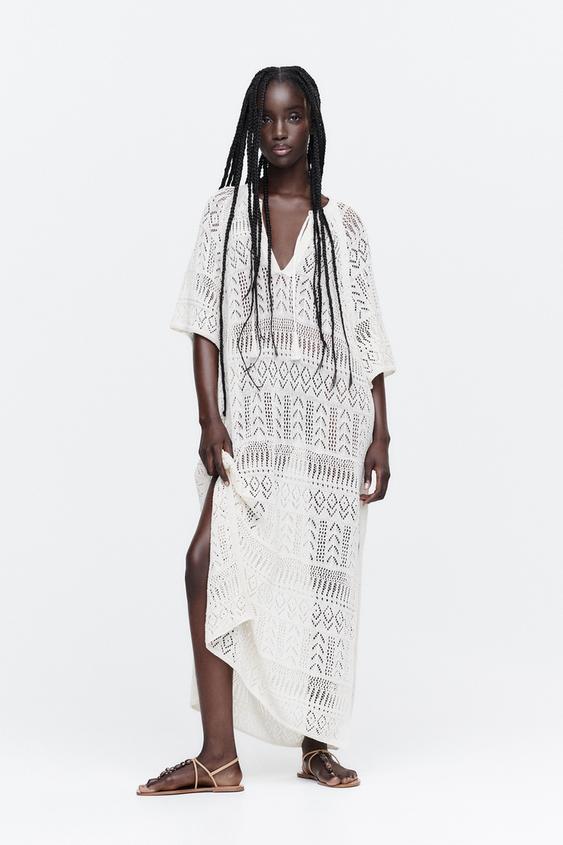
The kaftan style was well suited to the trends of the next decade, offering a basic silhouette that could be embellished as well as heavily pattern-based, or sleek and minimal (as seen in the designs of Halston from the late 1970s). The women who hosted parties at home wore this “kaftan dress,” while at the same time, more traditional styles were being brought into fashion in the United States and Europe by young people who had traveled through the emerging “Hippie trail” from North Africa to Afghanistan. The popularity of the kaftan in America of the kaftan–from premium to mass-market and even cheap imports–resulted from its connection with exoticism and also the easy-to-wear comfort of these pieces. From the late 1970s to the latter part of the century, the kaftan was absent from all the high fashion catwalks, instead being synonymous with clothes for resorts.
Shortened to micro-mini length, Tom Ford took the kaftan form to the realm of the erotic for Gucci Spring 1996. Designers who wanted to infuse their collections with the “oriental” touch and nostalgia for the 1960s rediscovered the versatility of the kaftan. Fashion designers such as Temperley as well as Matthew Williamson have continually reanimated the kaftan’s Bohemian beauty, and other designers like Naeem Khan or Elie Saab have brought the kaftan into the red carpet by incorporating intricately embossed and beaded versions. The striking and graphic design of the kaftan has allowed designers to each put their unique design on it, while always maintaining the simplicity of elegance and comfort that makes it so popular with women all over the world.